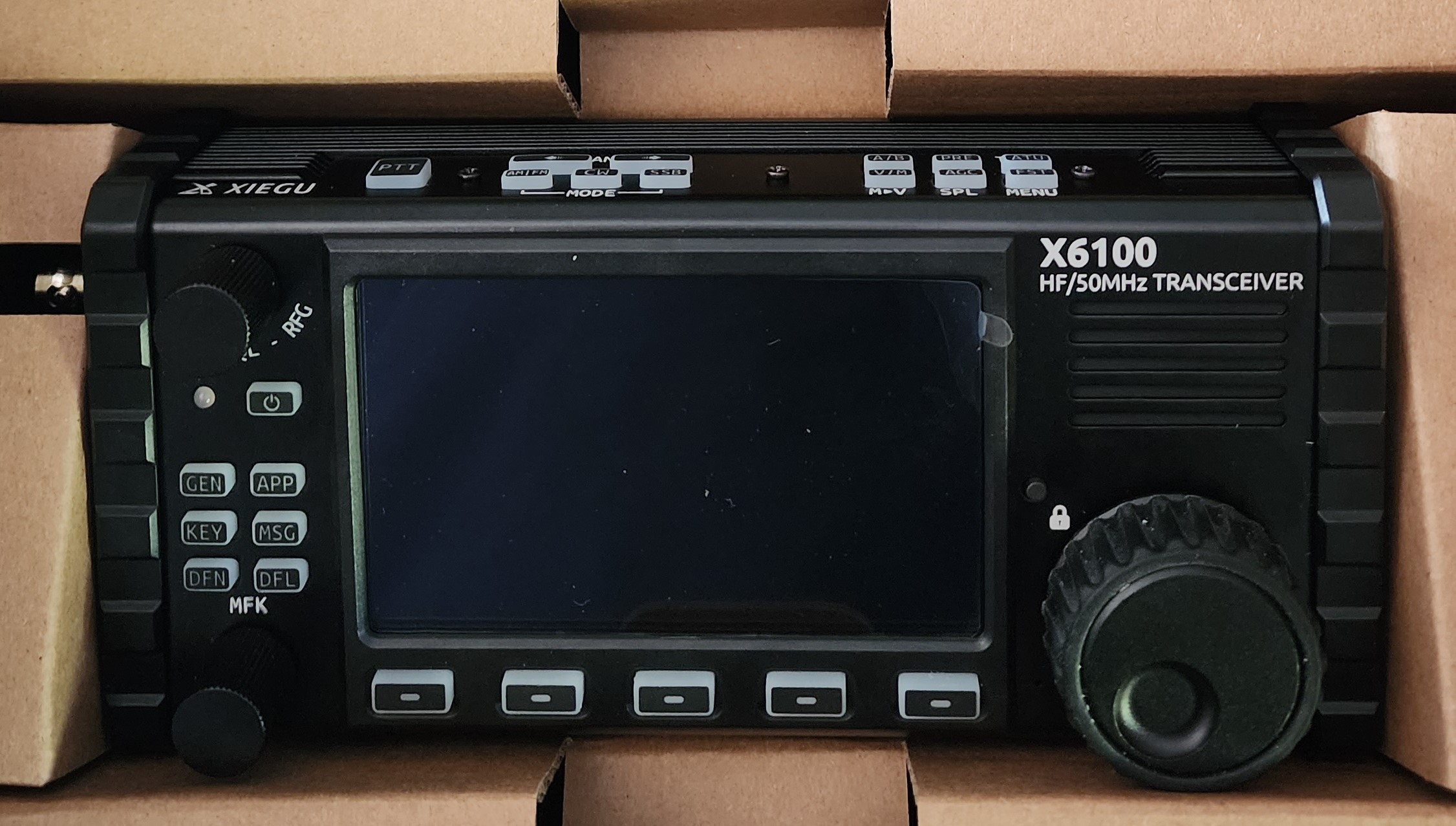
This is that radio that people either love or hate. I’m in the middle. Right out of the box it feels solid but that was the last moment I felt only one way about this radio. The manual states that the initial few charges should take about 8 hours. I found that it took much less time to get the steady green light. And that unsettled me, because a factory reset will make the radio look like new, but it doesn’t roll back the battery, which left me wondering if I was its first owner.
Once charged, I turned it on and was hit with this radio’s well-known problem of overload. I could hear AM stations all over the place. As I had read, one click of the ATT (attenuator) button made all that go away, but how many ham stations got lost? Later, I tried a broadcast band filter, and it cleared up the overload on 80m – 20m without the attenuator, but above that it was no help and I heard AM radio that didn’t flinch as I tuned or changed bands, so the attenuator is the ticket.
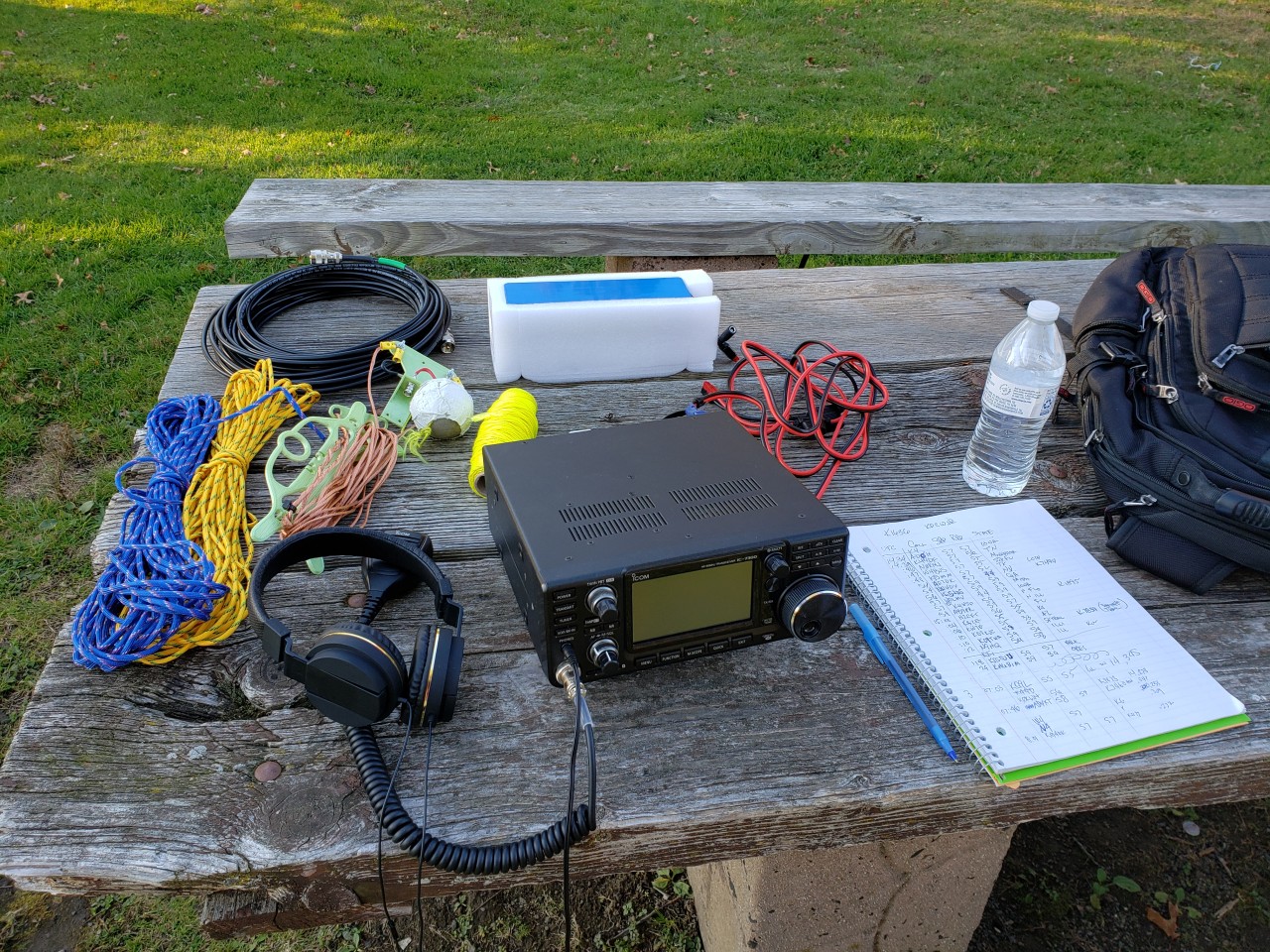
On the X6100, the bands looked relatively quiet, so I fired up my IC7300 and it turned out they were. Spoiled by my IC7300, which shows the entire band on the waterfall (except on 10m), I truly missed seeing that on the X6100. But when I tuned to the area of the band that was active, I saw the stations show up. I must mention another minor but truly unpleasant issue with the radio was that the tuning knob was so stiff, it felt like it shouldn’t be turned at all. I’ve read this can be adjusted easily with a 1.5mm hex key, but at this point my arm was feeling it and the dimple on the tuning knob was simply a bad joke.
I poked and prodded the buttons exploring the settings and confirmed that my filter was wide, all the noise reduction and blanking was off, and the firmware was even up to date. When I felt ready, I turned on the ATU and then long pressed the button to tune it. The radio was using its internal battery, so I was at 5 watts. Finally, I keyed the mike in response to a POTA from Ontario. As all “first calls” on a new rig should go, he came right back to me with a 57-signal report and an unsolicited comment about how good my audio was. I made a few more contacts, with surprising ease.
Then I connected my laptop. I had preinstalled the USB drivers for the radio. Some people say you don’t need to do that, but since they existed, I figured why not. I usually use OmniRig since it will let multiple programs talk to the radio in parallel. But OmniRig (v1.2) doesn’t really support the X6100. I used OmniRig with LOG4OM and the X6100, but things went badly when I added WSJT-X, so I learned to use LOG4OM without connecting it to the radio as WSJT-X sends all the necessary info to log QSOs.
Using the USB connection worked smoothly and as with SSB I made a quick contact and a few more to follow. At some point I pushed one of the menu buttons simply entering a menu, I changed nothing and exited the menu and then I got blasted with extremely loud FT8 (yes, I listen). The digital signal levels went through the roof too. This was hard to beat, even dropping the Line Out levels to 1 didn’t solve the problem. Finally, lowering the RF Gain to about half improved things. Later, turning off the radio and restarting it worked too. This problem happened from time to time. Other than managing the variable output levels, FT8 at 5 watts was smooth, easy, and surprisingly productive (-10 was about the cut-off for an easy reliable contact).
Getting ambitious I navigated to the Bluetooth settings, so I could try FT8CN from my phone. I enabled it and the radio froze – power-cycle. Over the next 48 hours, power-cycling the radio became routine. A second try at Bluetooth didn’t freeze the radio, but also, didn’t get me making FT8 contacts. Everything worked except transmitting. Sometimes the radio didn’t go into transmit mode and sometimes it would, but without audio. I even found an online video of someone not being able to get this to work. In all fairness, FT8CN is Alpha software, so it might not be the radio.
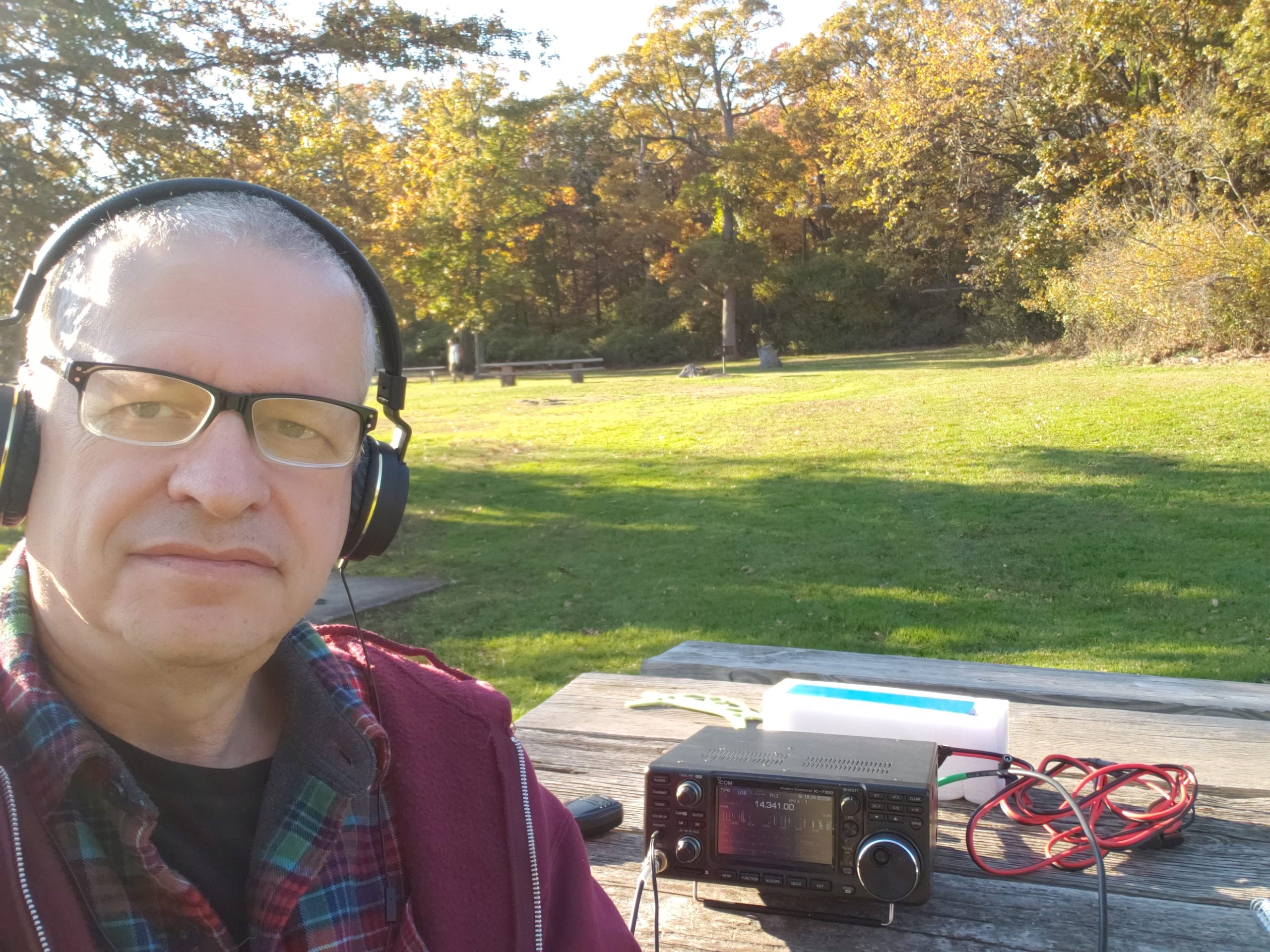
On my IC7300, I rarely use my attenuator, but I often combat the noise floor by turning down my RF Gain as well as using a healthy amount of Noise Reduction, and always using Noise Blanking and Auto Notching. I found that with the attenuator active on the X6100 I used very little to no Noise Reduction or Blanking. And any time I saw a station on my IC7300, and tuned there with the X6100, I found the station, so I didn’t lose too much with the attenuator. On occasion, I found the lightest Noise Reduction possible would make a very pleasant difference. The received audio quality is good when the volume is moderate or low, but turning the volume up, it gets very bad. This is true with both speakers and headphones.
I operated through a few charge/discharge cycles and found the radio just didn’t perform well when I pressed it to do anything fancy. And then there were the volume blasts when I would wander into some menu that shouldn’t affect anything. There were also many spontaneous stray noises, pops, and quirky moments when the waterfall would go all red.
Despite this, any time I just wanted to make a basic contact, I would. One was W1AW/4. There was a pile up of course, so the X6100 was no match. But after a few calls I heard “Was there a QRP in there?” and that was my cue. I made my call receiving another good signal report. When I returned his 59+20 I also mentioned my 5 watts. The operator expressed his surprise and enthusiastically told me I had a great signal for 5 watts from New Jersey to South Carolina. Clearly the radio can do something. Of course, I didn’t get the SSB contact from Moscow, but you know I tried.
I’ve taken my IC7300 into the field, but don’t enjoy that process. I was hoping to find a good basic radio that was compact and all-in-one – the unicorn. I had read the reviews, so I didn’t expect a unicorn, but I hoped the X6100 would be good enough. Specifically, I was looking for a radio that would make SSB contacts without having to take “extra bits” besides antennas. Along this line I also wanted a radio I could use for FT8 with my phone. And one last thing, I wanted it to just plain work. This isn’t that radio, maybe it will be some day, but I don’t know how many of the issues relate to hardware and how many can be fixed in software. I hope it will improve, but for now I’ve received my RMA# from Radioddity and it’s on its way back.
Rich Kopelow
kd2wjr