November 14, 2026 | Fairfield, New Jersey
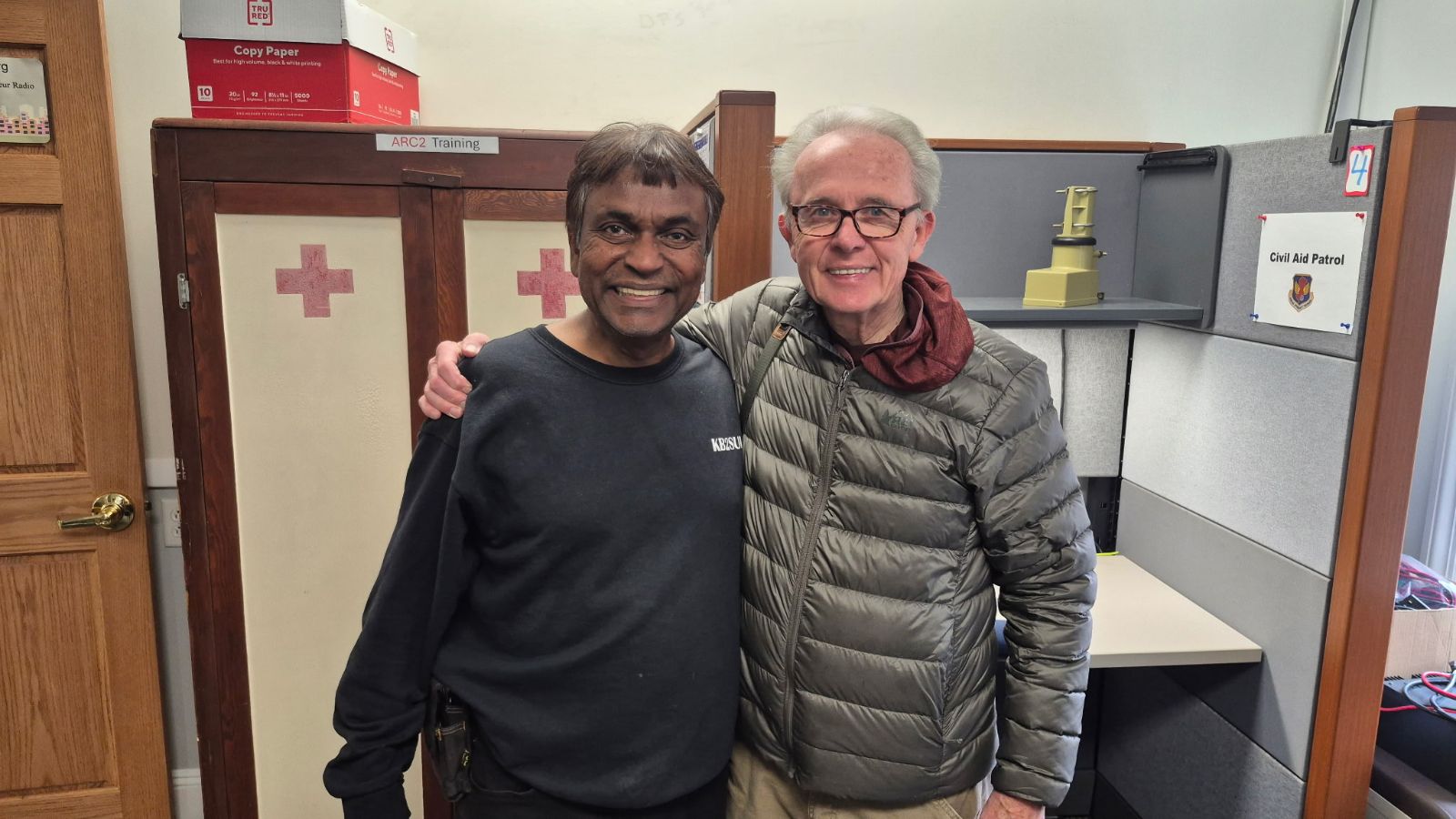
Amateur radio operators gathered Saturday morning at the American Red Cross facility in Fairfield, New Jersey, for a West Essex Amateur Radio Club (WEARC) operating session. The morning provided an opportunity to operate on the HF bands, explore digital communications, and collect additional performance data from the facility’s rooftop antenna installation.
With clear skies and temperatures around 40°F, the indoor operating environment was particularly welcome.
Conditions on the 10-meter amateur band were excellent during the morning. Shortly after sunrise, signals from stations thousands of miles away were readily heard, including stations throughout Europe and the western United States.
The session also provided an opportunity to examine an interesting characteristic observed during previous operating activities: differences between the signal strengths received at Fairfield and those reported by distant stations receiving transmissions from Fairfield.
The Operating Station
Saturday’s FT8 operation used equipment brought by Steve, KE2GVV, connected to the existing rooftop antenna system.
Operating configuration:
- Radio: Steve’s (KE2GVV) Icom IC-7300 MK2
- Operating mode: FT8 using WSJT-X
- Band: 10 meters, approximately 28.074 MHz
- Transmitter power: 30 watts, as recorded in the log
- Antenna: Rooftop tilted terminated folded dipole (T2FD)
- Location: American Red Cross, Fairfield, NJ
- Station callsign: KE2GVV
The T2FD antenna was installed and previously evaluated by WEARC members as part of the club’s ongoing activities at the Fairfield facility.
The antenna’s broadband design allows operation across multiple HF bands without requiring a conventional resonant antenna for each frequency. Its terminating resistor contributes to a relatively consistent impedance across a wide frequency range.
Previous testing included measurements of the antenna system’s standing wave ratio (SWR) and examination of the associated feedline and connections.
Additional details about that work are available in the club’s earlier article, WEARC Members Complete HF Antenna Testing at Fairfield Red Cross.
10-Meter Operating Conditions
The 10-meter band provided favorable conditions for long-distance communication throughout Saturday morning.
European signals were particularly prominent, with stations in Spain, Portugal, France, Belgium, the Netherlands, Germany, and England represented in the FT8 contact log.
A contact with N6WHV in Colorado demonstrated that propagation was also supporting communication across the continental United States.
The completed contacts covered approximate distances ranging from 1,600 to 3,850 miles.
Between 10:43 AM and 12:02 PM Eastern Standard Time, the station completed 11 FT8 contacts using 30 watts of transmitter power.
In addition to documenting these contacts, the WSJT-X log recorded the signal reports exchanged between the Fairfield station and its distant counterparts.
These measurements provide an opportunity to examine signal strength in both directions.
Examining the FT8 Signal Reports
One of the useful characteristics of FT8 is that each completed contact includes numerical signal reports.
These reports represent the receiving station’s estimate of signal-to-noise ratio (SNR), expressed in decibels.
For Saturday’s operation, we examined two measurements for each completed contact:
- Received at Fairfield: The signal-to-noise ratio of the distant station as measured by our receiver.
- Reported by the distant station: The signal-to-noise ratio of our transmission as measured by the receiving station.
The difference was calculated by subtracting the report measured at Fairfield from the report received from the distant station. A negative difference indicates that the distant station reported a lower signal-to-noise ratio.
November 14, 2026: FT8 Contact Data
| Station | Approx. Distance | Received at Fairfield | Reported by Distant Station | Difference |
|---|---|---|---|---|
| EB1CAR | 3,451 mi | −8 dB | −12 dB | −4 dB |
| M6JAY | 3,458 mi | +3 dB | −14 dB | −17 dB |
| F4LVE | 3,845 mi | −1 dB | −19 dB | −18 dB |
| N6WHV | 1,614 mi | −11 dB | −18 dB | −7 dB |
| PD9DY | 3,653 mi | −13 dB | −15 dB | −2 dB |
| CT1BOH | 3,397 mi | −4 dB | −12 dB | −8 dB |
| ON8WR | 3,598 mi | −3 dB | −14 dB | −11 dB |
| EA7Z | 3,524 mi | +14 dB | 0 dB | −14 dB |
| DN9CG | 3,731 mi | −6 dB | −16 dB | −10 dB |
| PD1HPB | 3,653 mi | −1 dB | −18 dB | −17 dB |
| EA2EED | 3,477 mi | +7 dB | −9 dB | −16 dB |
| Average | −2.1 dB | −13.4 dB | −11.3 dB |
Source: WSJT-X ADIF contact log, November 14, 2026. Distances are approximate great-circle distances based on logged Maidenhead grid squares.
Summary of the Measurements
The 11 completed contacts produced the following results:
| Measurement | Result |
|---|---|
| Completed FT8 contacts | 11 |
| Operating band | 10 meters |
| Transmitter power | 30 watts |
| Average signal received at Fairfield | −2.1 dB |
| Average signal reported by distant stations | −13.4 dB |
| Average report difference | −11.3 dB |
| Median report difference | −11 dB |
| Smallest difference | −2 dB |
| Largest difference | −18 dB |
| Contacts with lower reports from distant stations | 11 of 11 |
For all 11 completed contacts, the signal report measured at Fairfield was higher than the corresponding report received from the distant station.
The differences ranged from −2 dB to −18 dB, with an average of −11.3 dB.
For example, F4LVE in France was received at Fairfield at −1 dB, while the distant station reported receiving Fairfield at −19 dB, an 18 dB difference.
Similarly, M6JAY in England was received at +3 dB and reported Fairfield at −14 dB, a 17 dB difference.
The contact with N6WHV in Colorado showed a smaller difference of 7 dB, with reports of −11 dB at Fairfield and −18 dB at the distant station.
These measurements were obtained from contacts involving different stations, geographic locations, and propagation paths.
How Do These FT8 Reports Compare with SSB Voice Communication?
For operators more familiar with conventional SSB voice communication, FT8 signal reports can be difficult to interpret.
Unlike an S-meter, which indicates absolute received signal strength, FT8 reports express the signal-to-noise ratio measured by the decoding software.
An FT8 signal can be successfully decoded even when its reported signal-to-noise ratio is well below 0 dB.
This is possible because FT8 uses narrowband digital signaling and error-correction techniques designed for weak-signal communication.
Traditional SSB voice communication requires a more favorable signal-to-noise ratio for intelligible speech.
Could These Contacts Have Been Completed Using SSB?
This is an interesting question when considering the practical operating capabilities of the Fairfield station.
FT8 reports are referenced to a noise bandwidth of approximately 2,500 Hz, comparable to the bandwidth used for SSB voice reception. However, FT8 can decode signals at substantially lower signal-to-noise ratios than those generally required for understandable voice communication.
Consider the signal reports received from the distant stations during Saturday’s operation:
| FT8 Report | General Comparison with SSB Reception |
|---|---|
| +10 dB or higher | Generally favorable signal-to-noise ratio for understandable SSB speech |
| 0 to +10 dB | SSB speech may be understandable, depending on noise, fading, and receiver conditions |
| −10 to 0 dB | SSB communication becomes increasingly difficult; FT8 remains usable |
| −20 to −10 dB | Generally unsuitable for reliable SSB voice communication under comparable conditions, although FT8 may decode successfully |
These are approximate comparisons based on signal-to-noise ratio, not direct S-meter conversions or guaranteed voice intelligibility thresholds.
The Fairfield FT8 log shows that distant stations reported receiving our transmissions at levels ranging from −19 dB to 0 dB, with an average of −13.4 dB.
Of the 11 completed contacts, ten were reported below 0 dB, while one station reported 0 dB.
Under otherwise comparable receiving conditions, most of these signal-to-noise ratios would present significant challenges for conventional SSB voice communication.
However, the log does not establish how an actual SSB transmission would have been received. Differences in transmitter power, modulation characteristics, propagation, and receiving conditions would influence the result.
What Can We Learn from Saturday’s Operation?
Saturday’s operating session demonstrated that the Fairfield station was capable of completing FT8 contacts over considerable distances on the 10-meter band, including multiple transatlantic paths.
It also produced an interesting set of measurements.
Across 11 completed contacts, the average signal received at Fairfield was −2.1 dB, while the average report received from distant stations was −13.4 dB.
Every completed contact showed a lower reported signal-to-noise ratio at the distant station, with an average difference of 11.3 dB.
The results also illustrate the distinction between successfully completing a weak-signal digital contact and establishing reliable two-way SSB voice communication.
What do these observations tell us about the operational characteristics of the Fairfield station?
How might the rooftop T2FD antenna, transmitter power, distant receiving environments, and propagation conditions contribute to the measurements?
And how might the experience differ if the same stations attempted traditional SSB voice contacts instead of FT8?
Amateur radio provides an opportunity not only to communicate over remarkable distances, but also to observe, measure, and better understand the equipment and systems that make those communications possible.


Leave a Reply
You must be logged in to post a comment.