Category: WEARC Blog

  • If you like FT8, perhaps you will love JS8Call

    If you like FT8, perhaps you will love JS8Call

    I got into using FT8 this summer when camping. In 2023 now post COVID I had to adapt to having other campers close by which made it embarrassing to be talking to myself late at night and possibly annoying my fellow campers. I was lucky and able to download all the software and get it running on my laptop during a wet day and then spend the night exchanging contacts using a variant of WSJT-X, JTDX. I improved things by adding GridTracker and spent much of the summer evening working through FT8.  

    Laptop Screen when integrated with GridTracker

    Good as FT8 is, it didn’t satisfy my itch to communicate. It was good at getting to stations, finding out where you could be heard. But just a signal report and location didn’t feel sufficient. I stumbled on a fork of FT8 called JS8-Call. Developed by KN4CRD back at the end of 2019 it takes much of FT8 but adds texting. So, you can now have a QSO, although slowly. To quote KN4CDR “JS8Call is an experiment in combining the robustness of FT8 (a weak-signal mode by K1JT) with a messaging and network protocol layer for weak signal communication.” This code base is well supported (for Ham software) and has a last release of June 2020. There is an active community with sufficient activity to be able QSO most of the time.

    The user interface and operation of JS8Call is different than FT8. They look quite different, but I quickly got used to the new layout. Before writing this blog, I went on air to get some typical screen captures to share what I like about it and why I feel it important to share availability of this digital mode.

    The top things I really like are:

    • You can send and receive text messages and so exchange type of rig, antenna, power and such. You also have a chance to spend as long as you both like chatting.
    • There is an automated heartbeat mode where you can send automated messages and get replies including your signal strength.

    Main disappointment so far

    No automatic link into GridTracker, although might be possible with some work.

    JS8Call screen during a QSO

    The picture above shows the main screen, you will see that it has the waterfall of activity, above on the left is a list of activities, in the middle you can see the text messages for the current QSO and to the right a list of stations heard. The setup required all the same information as FT8, and I used my radio USB for audio and CAT commands for control. It has interfaces to a central logging program and can be configured for various unattended auto replies as well as full manual operation. It has become something I leave on in the shack and get satisfaction looking where I am being heard.

    JS8Call screen response to a heartbeat

    This second screen capture shows the responses to an automated heartbeat, you can see a bunch of people responded to my heartbeat with a signal strength. I like this feature as it gives me confidence everything is working.

    The system has interesting features a club might want to explore. You can define groups, say the WEARC Group, then messages can be filtered and sent to the group and the group could automatically reply with the heard signal strength.There are also special groups with some set operating periods all designed for interfacing to APRS Packet network. 

    Most of my operation was portable and so I was not as experimental as I am back here in the Shack. I want to look at the different modes available as some are faster (less weak signal capable) also try out the many shortcut messages and options which might make it simpler to cover the more standard messages and questions.

    If I had to sum up what JS8Call feels like in one short sentence, it would be modern day CW mode, since JS8Call has almost the same message speed and probably works in harsher signal conditions.

    I hope a few more club members try this and perhaps we can form our own group able to get automated signal measurements on the major bands between us all.

    Please comments welcome.

  • Blind Mic Test

    Blind Mic Test

    I believe most hams have the same question as I did. Does it pay to spend a lot of money on a high quality microphone? This question bugged me for quite some time so I decided to do something about it. I came up with the idea of doing a blind mic test with several different mics on the air. I used the following mics in the test (with their approximate retail value): 

    1 – Electro Voice RE-320 Broadcast Mic ($300.00)

    2 – Shure SM58 Vocal Mic ($100.00)

    3 – AKG D8000M Vocal Mic ($50.00)

    4 – Heil HM10XD Communications Mic ($140.00)

    5 – Kenwood MC60A Communications Mic ($160.00)

    Starting with the most expensive mic, the Electro Voice, this mic is designed for broadcast applications. It is a less expensive version of the RE-20, which is probably the most popular mic used in broadcast radio stations and podcasts. The RE-320 has the “Dual Personality” EQ switch which can be set to flat or kick drum. When the EQ is set to the kick drum position, the bass begins to roll off at around 800 Hz. The overall frequency response is 30 – 18,000 Hz in the kick drum mode and 45 – 18,000 Hz in the standard mode.

    The second mic used in the test was the Shure SM58. This mic is arguably the most popular vocal mic on the market. The Shure mic is famous for three basic attributes, quality, consistency, and durability. It is popular with music groups as well as many performing artists that need a handheld mic. The overall frequency response of this mic is 50 – 15,000 Hz.

    The third mic in the challenge is an inexpensive vocal mic by AKG, the D8000M. This mic shows great specs for the money with an overall frequency response of 40 – 20,000 Hz. I have used this mic for recording live music and it did a great job. I found it to be impressive for the money.

    The fourth mic used in this comparison was the Heil HM10XD. This mic is specifically built for ham radio. This mic includes two elements. The HC-5X is used when the two position switch is set to the wide mode. The HC-4X is used for the narrow mode. When the mic is in the narrow mode, it has a +10 dB rise at 2,500 Hz which Heil claims will help punch through the pile ups. In the wide mode, the rise at 2,500 Hz is +6 dB which Heil says makes rag chewing more pleasing. The overall frequency response in the wide range is 300 – 8,000 Hz and 600 – 6,000 Hz in the narrow range.

    The fifth and final mic in the test was the Kenwood MC60A. Although this mic has a switchable preamp, the entire test was done with the preamp on and low impedance. The overall frequency response of the Kenwood using the attributes as mentioned is 200 – 7,000 Hz.

    Several hams helped me with this project. I would like to thank Benett, AC2NI, John, N2HMM, Rich, KD2WJR, and Bob W2FKG. All of the tests were conducted in the HF bands including 80, 40 and 10 meters. The radio used was my Kenwood TS890S and the built in equalizer was kept flat for the entire test. The only adjustment made was increasing the gain for the Heil mic as it was substantially lower in output than all of the other mics.

    Here is some of the feedback I received:

    Electro Voice RE-320

    • Sounds fuller with EQ off
    • May not be good for DX
    • Sounds fuller than the other mics
    • Lows are stronger than highs
    • Lower mid and high end
    • Mids increased when EQ is on
    • Sounds more like my voice in real life with EQ on

    Shure SM58

    • The EV was more broadcast quality
    • The Shure sounded better for communication
    • Sounds like the RE-320 with the EQ on
    • Feels brighter, just sounds better overall

    AKG D8000M

    • Identical comments of the Shure SM58
    • Sound like the RE-320 with EQ off but more bass
    • Hard to tell the difference compared to the SM58

    Heil HM10XD Wide Mode

    • Sound tinny
    • Much lower output than the others
    • Not a full sound
    • May be good for DX
    • Punchy on high end
    • Harsh, no lows, very tinny
    • Very low gain

    Heil HM10XD Narrow Mode

    • Lower level than wide
    • Less bass
    • Audio sound pinched
    • All highs, no lows, very tinny
    • Very low gain

    Kenwood MC60A

    • Well rounded sound
    • Full sound
    • Pleasant to listen to
    • Sounds a bit like it is in a cave

    After listening to all the comments, it left me wondering, does it pay to buy an expensive mic? I am not sure it does. I tend to think you can make enough adjustments to the mic using the radio’s (or external) EQ. You be the judge. Here are some sound bits of the mics tested. 

    Electro Voice RE-320 EQ Off

    Electro Voice RE-320 EQ On

    Electro Voice RE-320 EQ Off Then On

    Shure SM58

    AKG D8000M

    Heil HM10XD Wide

    Heil HM10XD Narrow

    Kenwood MC60A

     After listening, please add your comments below.

  • The best commuter backup communications plan (Part 1 – The problem,  the bad solution and a possible solution)

    The best commuter backup communications plan (Part 1 – The problem, the bad solution and a possible solution)

    As many people that commute daily to work, I take all the complex systems that support me for granted. I start my day in the suburbs of New Jersey driving my car to the train station, get there 5 mins earlier and check my phone to see how the line is operating. The train is almost always on time, I get a seat and enjoy my 5G connection to read the news to know what is going on, I check my emails, I interact with people on social media and when the train slows down, I use my GPS to check how far I’m from the office in NYC. 40 mins later I’m at Penn Station.

    In 1h I exchange a lot of information and a question comes to my mind. What happens IF all these complex and inter connected infrastructure fails? How do I check what is going on, how do I check what route I should take to get back home? And most importantly, how do I keep in touch with my friends and family to check if they are ok?

    As an amateur radio operator for a few years, the answer seems easy. I just use a radio. The tool to solve most of the communication challenges is easy to define but the know-how is the most critical aspect. Just because you own a hammer, it doesn’t mean you know how to build a house. The monumental communication tasks that we perform from the toilet look like magic due to the heavy layers of technologies operating in perfect synchrony popping all you need in the palm of your hands. This magic also distract us from remembering phone numbers, knowing where we are and sometimes even how to effectively communicate with another human being right in front of us.

    Since my commute takes one hour and I usually solve my Wordo, check all my social media, weather etc in 10 mins, I dedicate the remaining of the time to develop a framework to effectively locate MYSELF, inform MYSELF and communicate with others with MY OWN means.

    I want to share with you the tools and most importantly the know-how to at the same time to structure my thinking and to learn from NEGATIVE feedback because I was born in the 80’s and this is how I learn faster and more effectively.

    First let me eliminate the stupid ideas. HF is not the solution for sure. HF needs too much equipment and too much knowledge to make it work and we will not accomplish anything carrying a 100 pounds of equipment or finding a place to hang an end fed antenna in an emergency. Most of us can’t do it properly not even when we have all time and tools available.

    Next obvious answer is to carry a “high quality” HT with the local repeaters preprogrammed and try to reach one. Problem is… how do you align with whoever is trying to talk to you the frequency, time etc… Other thing is, there is no “voice mail” so even if your equipment works and does everything right, these 2 things need to be happening at the RIGHT TIME and in the RIGHT PLACE. Too many factors so this would be a possible BUT “unlikely to work” solution.

    We are trying to mitigate the RISK of something else to fail and just as a reminder: “Risk is the combination of likelihood and severity.” per Dr. Google. Adapting this to our scenario, likelihood would be related to the amount of times you would need to perform a task correctly and the severity would be the damage to the final goal if something doesn’t work properly.

    With this principle in mind, we narrow down to a communication system that allows you to acquire information as fast as possible verbally (via FM radio, people talking in local repeaters, emergency agencies etc) and at the same time to send messages that are “stored” in text so there is a logging system with the message itself, the time and the location. The system needs to be compact, operate with low power consumption (QRP) and relatively easy to operate, even better if it can have redundancy to make sure we connect 2 points via multiple routes and alternative ways.

    Now let’s get closer to a possible solution: APRS using a USBC chargeable HT + a simple cable. This is one of the best solutions that could work in easily and effectively. 5W can reach 100 miles easily with no barrier and in 2m frequencies (144 MHz) it can get far even in the middle of buildings.

    If you keep an old smartphone in your house connected to a radio and a battery eliminator, you can even have an iGate, Digipeter with the IGATE2 PRO APP. No power, no problem… with simple battery banks AND/OR small solar panels, you can get days of reliable communication that is logging all communication traffic that it can receive. 

    https://play.google.com/store/apps/details?id=adn.IGate2.Pro&hl=en_US&gl=US

    Each APRS message sent via APRS Droid uses your phone GPS to send the messages with the coordinates, time and even some basic telemetry. Good thing is that besides the KISS connection, you can also use TCIP (internet) in “normal conditions” to practice. Some nodes of this infrastructure are connected to the internet and once you reach one VIA RADIO or VIA INTERNET, by using the right commands, you can send emails, WhatsApp messages. Another useful function is to request the weather reading from the closest weather stations around you 100% via radio.

    From the “commuter” perspective, by carrying a small HT (preferably USB-C chargeable) , a small cable, you have the ability to use your own phone and by saving offline maps, to have a powerful communication tool.

    The other positive aspect is the redundancy. A lot of the operators are repeaters so this is a MESH style solution. Mesh means that the message is repeated multiple times and even if one node fails, another will e able to relay the message (that by the way takes a sec or 2 to be transmitted).Having a quick burst of information via text makes the system very power efficient. The phone battery will be the limitation but with a battery bank, this can be solved. Messages are also only transcribed by people using the same technology. APRS.FI website: https://aprs.fi

    APRS works in only 1 frequency 144.390. IF you have a new phone W/O a 3.5mm audio jack, you can use a simple adaptor.

    That’s all for an initial introduction and an overview of one possible solution. In the next articles of these series we will keep exploring other solutions and later on we will have some deep dives into how to make something that works instead of just talking about possibilities.

    Need to go, my train is arriving. Penn Station is at smelling distance.

    73

    KD2WWU

  • J-Pole Antenna Tuning

    J-Pole Antenna Tuning

    We have a new project!!!!

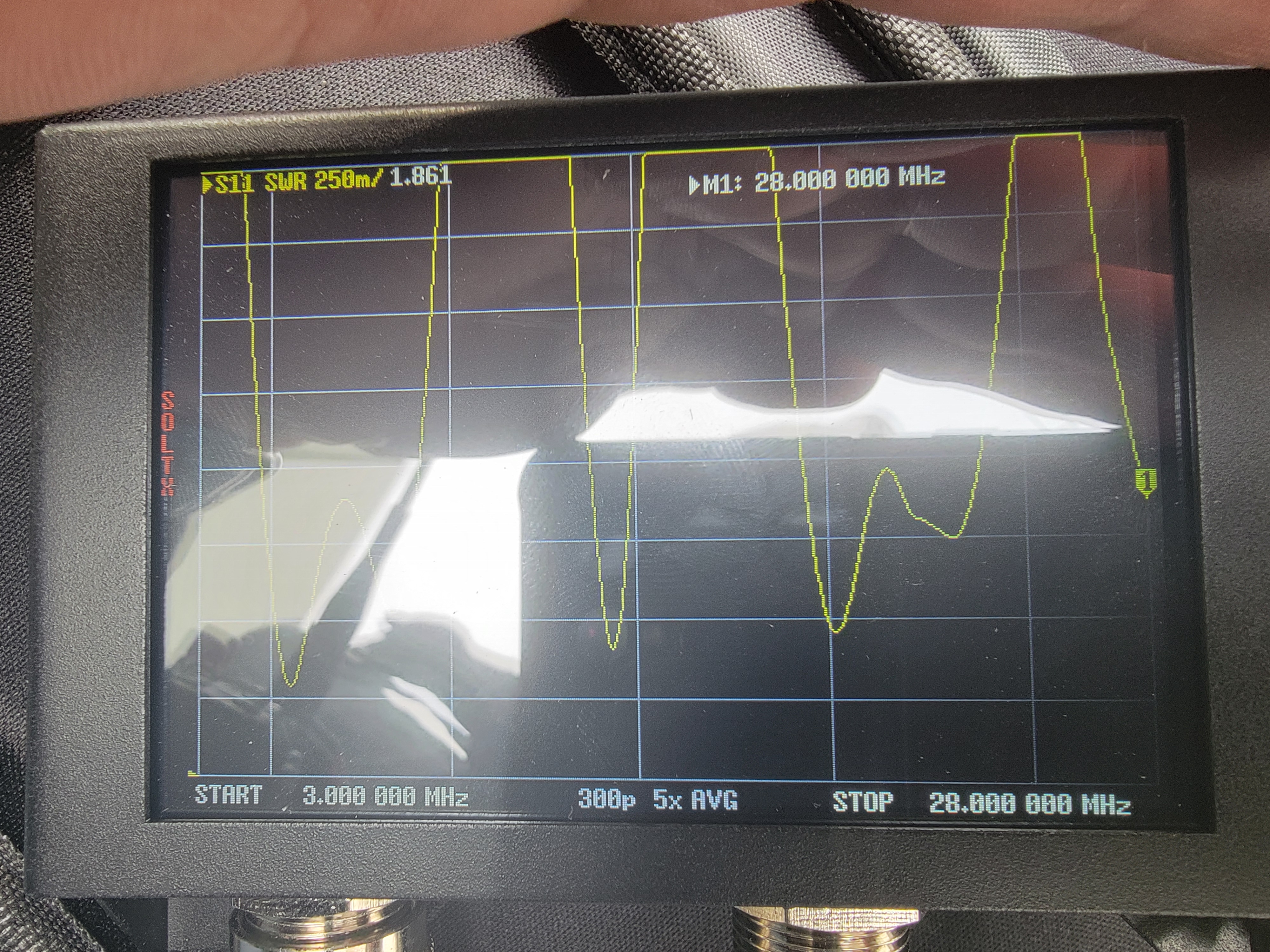
    Tuning a J-pole antenna is a crucial step in optimizing its performance for a specific frequency or frequency range. The tuning process involves adjusting the lengths of the antenna elements to resonate at the desired frequency, which ensures maximum efficiency and a low standing wave ratio (SWR). Here’s a guide on how to tune a J-pole antenna:

    1. Prepare Necessary Tools:

    • SWR Meter or Antenna Analyzer: This tool is essential for measuring the standing wave ratio and ensuring that the antenna is properly tuned.
    • Coaxial Cable: Use a length of coaxial cable to connect your J-pole antenna to the SWR meter or antenna analyzer.
    • Adjustment Tools: Depending on your J-pole design, you might need tools to adjust the length of the elements. This could include a hacksaw for cutting tubing or wire, as well as a soldering iron if adjustments involve soldered connections.

    2. Initial Assembly:

    • Construct the J-pole: Build the J-pole antenna according to the design specifications. Follow the calculations for element lengths based on the target frequency.

    3. Install the J-pole:

    • Mount the Antenna: Install the J-pole in its intended location. Ensure that it is clear of obstructions and properly grounded if required.

    4. Connect SWR Meter:

    • Connect Coaxial Cable: Use a length of coaxial cable to connect the J-pole antenna to the SWR meter or antenna analyzer. Connect one end to the antenna feed point and the other to the SWR meter.

    5. Measure SWR:

    • Check Initial SWR: Transmit a test signal and observe the SWR readings on the meter. A high SWR indicates that the antenna needs tuning.

    6. Adjust Element Lengths:

    • Fine-tune the Lengths: If the SWR is too high, adjustments to the element lengths are needed. Make small adjustments, either by trimming or extending the lengths, and recheck the SWR after each modification.
    • Repeat the Process: Iterate this process until the SWR readings are within an acceptable range. Aim for an SWR close to 1:1 for optimal performance.

    7. Test Across Frequencies:

    • Check Bandwidth: Verify that the antenna performs well across the entire frequency band of interest. Make additional adjustments if necessary.

    8. Secure Connections:

    • Once Optimized: Once the SWR is within an acceptable range and the antenna is performing well, secure all connections to prevent unintentional changes.

    9. Final Installation:

    • Securely Mount the Antenna: If adjustments have been made, ensure the antenna is securely mounted in its final position.

    By carefully following these steps and making gradual adjustments, you can effectively tune a J-pole antenna for optimal performance on your desired frequency or frequency range. 

    Photo Credit: Mike Abbey

  • 2 Days with an X6100

    2 Days with an X6100

    This is that radio that people either love or hate. I’m in the middle. Right out of the box it feels solid but that was the last moment I felt only one way about this radio. The manual states that the initial few charges should take about 8 hours. I found that it took much less time to get the steady green light. And that unsettled me, because a factory reset will make the radio look like new, but it doesn’t roll back the battery, which left me wondering if I was its first owner.

    Once charged, I turned it on and was hit with this radio’s well-known problem of overload. I could hear AM stations all over the place. As I had read, one click of the ATT (attenuator) button made all that go away, but how many ham stations got lost? Later, I tried a broadcast band filter, and it cleared up the overload on 80m – 20m without the attenuator, but above that it was no help and I heard AM radio that didn’t flinch as I tuned or changed bands, so the attenuator is the ticket.

    On the X6100, the bands looked relatively quiet, so I fired up my IC7300 and it turned out they were. Spoiled by my IC7300, which shows the entire band on the waterfall (except on 10m), I truly missed seeing that on the X6100. But when I tuned to the area of the band that was active, I saw the stations show up. I must mention another minor but truly unpleasant issue with the radio was that the tuning knob was so stiff, it felt like it shouldn’t be turned at all. I’ve read this can be adjusted easily with a 1.5mm hex key, but at this point my arm was feeling it and the dimple on the tuning knob was simply a bad joke.

    I poked and prodded the buttons exploring the settings and confirmed that my filter was wide, all the noise reduction and blanking was off, and the firmware was even up to date. When I felt ready, I turned on the ATU and then long pressed the button to tune it. The radio was using its internal battery, so I was at 5 watts. Finally, I keyed the mike in response to a POTA from Ontario. As all “first calls” on a new rig should go, he came right back to me with a 57-signal report and an unsolicited comment about how good my audio was. I made a few more contacts, with surprising ease.

    Then I connected my laptop. I had preinstalled the USB drivers for the radio. Some people say you don’t need to do that, but since they existed, I figured why not. I usually use OmniRig since it will let multiple programs talk to the radio in parallel. But OmniRig (v1.2) doesn’t really support the X6100. I used OmniRig with LOG4OM and the X6100, but things went badly when I added WSJT-X, so I learned to use LOG4OM without connecting it to the radio as WSJT-X sends all the necessary info to log QSOs.

    Using the USB connection worked smoothly and as with SSB I made a quick contact and a few more to follow. At some point I pushed one of the menu buttons simply entering a menu, I changed nothing and exited the menu and then I got blasted with extremely loud FT8 (yes, I listen). The digital signal levels went through the roof too. This was hard to beat, even dropping the Line Out levels to 1 didn’t solve the problem. Finally, lowering the RF Gain to about half improved things. Later, turning off the radio and restarting it worked too. This problem happened from time to time. Other than managing the variable output levels, FT8 at 5 watts was smooth, easy, and surprisingly productive (-10 was about the cut-off for an easy reliable contact).

    Getting ambitious I navigated to the Bluetooth settings, so I could try FT8CN from my phone. I enabled it and the radio froze – power-cycle. Over the next 48 hours, power-cycling the radio became routine. A second try at Bluetooth didn’t freeze the radio, but also, didn’t get me making FT8 contacts. Everything worked except transmitting. Sometimes the radio didn’t go into transmit mode and sometimes it would, but without audio. I even found an online video of someone not being able to get this to work. In all fairness, FT8CN is Alpha software, so it might not be the radio.

    On my IC7300, I rarely use my attenuator, but I often combat the noise floor by turning down my RF Gain as well as using a healthy amount of Noise Reduction, and always using Noise Blanking and Auto Notching. I found that with the attenuator active on the X6100 I used very little to no Noise Reduction or Blanking. And any time I saw a station on my IC7300, and tuned there with the X6100, I found the station, so I didn’t lose too much with the attenuator. On occasion, I found the lightest Noise Reduction possible would make a very pleasant difference. The received audio quality is good when the volume is moderate or low, but turning the volume up, it gets very bad. This is true with both speakers and headphones.

    I operated through a few charge/discharge cycles and found the radio just didn’t perform well when I pressed it to do anything fancy. And then there were the volume blasts when I would wander into some menu that shouldn’t affect anything. There were also many spontaneous stray noises, pops, and quirky moments when the waterfall would go all red.

    Despite this, any time I just wanted to make a basic contact, I would. One was W1AW/4. There was a pile up of course, so the X6100 was no match. But after a few calls I heard “Was there a QRP in there?” and that was my cue. I made my call receiving another good signal report. When I returned his 59+20 I also mentioned my 5 watts. The operator expressed his surprise and enthusiastically told me I had a great signal for 5 watts from New Jersey to South Carolina. Clearly the radio can do something. Of course, I didn’t get the SSB contact from Moscow, but you know I tried.

    I’ve taken my IC7300 into the field, but don’t enjoy that process. I was hoping to find a good basic radio that was compact and all-in-one – the unicorn. I had read the reviews, so I didn’t expect a unicorn, but I hoped the X6100 would be good enough. Specifically, I was looking for a radio that would make SSB contacts without having to take “extra bits” besides antennas. Along this line I also wanted a radio I could use for FT8 with my phone. And one last thing, I wanted it to just plain work. This isn’t that radio, maybe it will be some day, but I don’t know how many of the issues relate to hardware and how many can be fixed in software. I hope it will improve, but for now I’ve received my RMA# from Radioddity and it’s on its way back.

    Rich Kopelow
    kd2wjr

  • Simple Guide for a POTA activation

    Simple Guide for a POTA activation

    To conduct a POTA (Parks on the Air) activation, which involves operating amateur radio equipment from a designated park or natural area, follow these general steps:

    1. Research Parks: Identify parks or natural areas that are eligible for POTA activations. You can visit the POTA website (https://parksontheair.com/) or use the POTA mobile app to find eligible parks near your location. Make sure to check the rules and regulations specific to the park you plan to activate.
    2. Obtain Permits (if necessary): Some parks may require permits or permissions for radio operations. Contact the park authorities to inquire about any specific requirements and obtain the necessary permits or permissions well in advance of your planned activation date.
    3. Plan Your Activation: Determine the date, time, and duration of your activation. Consider factors such as weather conditions, park accessibility, and potential interference from other activities in the park. Prepare a detailed plan including the equipment you will use, the bands and frequencies you intend to operate on, and any special considerations for antenna setup.
    4. Set up Your Equipment: Gather all the required amateur radio equipment, including your transceiver, power source, antennas, cables, and any accessories. Set up your equipment according to your plan, ensuring proper grounding and compliance with safety regulations.
    5. Antenna Deployment: Install and configure your antenna system based on the available space and park regulations. Consider using portable or temporary antenna solutions such as wire antennas, vertical antennas, or magnetic loop antennas. Ensure that your antenna installation is safe and does not cause any harm to the environment or park structures.
    6. Make Contacts: Begin operating your amateur radio equipment and start making contacts with other amateur radio operators. Use the designated POTA frequencies or work the bands that provide the best propagation conditions at that time. Be courteous and follow good operating practices, adhering to the regulations and guidelines set by your licensing authority.
    7. Log Your Contacts: Maintain an accurate log of all your contacts during the activation. Include relevant information such as the call signs of the stations worked, the time of contact, the band and frequency used, and any additional details required for POTA credit. Ensure that your log is complete and legible.
    8. Share Your Activation: After completing your activation, consider sharing your experience with the amateur radio community. Upload your log to the POTA website or app to receive credit for your activation and contribute to the POTA program. Share photos, videos, or blog posts on social media or amateur radio forums to engage with fellow operators and promote the POTA program.

    Remember to always respect park rules and regulations, practice good environmental stewardship, and represent the amateur radio community positively during your POTA activation. Enjoy the opportunity to operate outdoors and explore the beauty of nature while pursuing your amateur radio hobby. 

  • WEARC Fox Hunt April 2023

    WEARC Fox Hunt April 2023

    The fox:

    Bionics MicroFox 15 (@146.565 MHz)

    https://www.byonics.com/mf


    The “hunting weapons”:


    MWRF Source SMA Male to SMA Female 6GHz Attenuator 2W (30 dB)

    The greatest transceiver of all times: Baofeng UV5R  

    SDR: Nooelec RTL-SDR v5 SDR – NESDR Smart HF/VHF/UHF (100kHz-1.75GHz)

    USB C Male to USB female adaptor

    Compass: BIJIA Orienteering Map Compass


    Yagi:

    Metal broom handle from the Dollar Tree

    Measure tape from the Dollar Tree

    RG8X Coax + BNC connector

    3D printed support for the measuring tape 

    Loop Antenna:

    Just a piece of coax and a BNC connector. At the top there is only a coax’s shield gap of 1 inch. Pencil is just giving support to the cable. 

    https://www.youtube.com/watch?v=zJbBWm6KyOM

    Software:

    App to calculate antenna dimensions:

    https://play.google.com/store/apps/details?id=com.daveyhollenberg.amateurradiotoolkit

    SDR for the Android (also available for iPhone):

    https://play.google.com/store/apps/details?id=marto.androsdr2

    Premium key ($10,99):

    https://play.google.com/store/apps/details?id=marto.androsdr.key

    Driver (to connect to any SRD USB rig):

    https://play.google.com/store/apps/details?id=marto.rtl_tcp_andro

    App to mark the bearings:

    SigTrax ($3.99)

    https://play.google.com/store/apps/details?id=com.amcept.sigtrax


    We started at 10AM at the Red Cross parking lot (Point 1 on the map below). Jerry initiated transmission from his HT with 5W in 10-minute intervals, we got 2 bearings (both off) and Yagi was pointing Northwest, Loop was pointing West but also reading Northwest when elevated a couple feet. We decided to go Northeast to a park at Point 2 on the map, at which point we both got a good reading. We were agreeing 100%, and the bearing was PRECISILY pointing to the fox. This was impressive.

    However, we were not very confident at that point because it was a parallel line to the fist bearing, but both were pointing West, so we decided to go all the way North to Point 3 where we got the first intersection with bearing from Point 2.

    Driving to Point 4 was our best option because we were almost getting out of the 5 mile range, and the signal was strong. We used the attenuator and Jerry called to say that he was going to use just the low power (15mW). Pressure was on. Interesting enough, driving around the car’s mobile radio started to receive even in low power. We knew we were close. At Point 4 the Yagi was not very precise, but the loop antenna got a PERFECT bearing Southwest so we narrowed down to the nearest park/public area.

    We were close but we got a lot of signals bouncing around in multiple directions. We used the HTs with the rubber ducky antennas. Key factor here was to use our bodies as a barrier to confirm the direction that was not receiving. Holding the HT close we were able to determinate the rough direction and walked 1 block to Point 5 where we saw Jerry! 

    From that point we just removed the antenna completely, walked around using the “body shield technique”, and voila! Fox was found. 

    1:43hs in total (coming back to Red Cross only took 12 minutes). Total distance traveled was 7.99 miles. We used Komoot app to track and made a nice video using the Relive app:

    https://www.relive.cc/view/vWqB3jLMmQv


    Tips and improvement opportunities: 

    1. Clearly it’s is a team effort, one driver and one navigator with an Yagi would speed up the process a lot. It might be better to use aluminum wire and a PVC pipe to get a more stable structure and put the antenna outside of the car while driving. A good bearing could be taken in open areas with no buildings around and small corrections could be done while moving.

    2. It’s extremely important to plan, check the topography to understand where the signal could bounce and try not to go straight to the initial direction but at least 30 degrees off the last bearing to triangulate.

    3. Without a signal strength meter it would be impossible. The SDR provides precise readings. Attenuators are very important from close range but it would be nice to have more options, maybe 10 db, 20 db and 30 db and not only one 30 db. Best option is to build a decent one. 

    4. Instead of using our body as shields, a better solution could be to use a can and a mini antenna tuned in the 3rd harmonic (fox frequency X 3 => 146.565 * 3 = 469.695 MHz).

    Some ideas to be tested: 

    Overall, it was a great experience. From building directional antennas to training navigation skills, this simple and fun experience will test your abilities. We are ready for the next one! 

    Best reference to learn more about Fox Hunts: http://www.homingin.com/

    Special thanks to Jerry, WB2GZL. He idealized, gave us all the guidance, hid the fox and helped us every step of way!  

    73s

    KD2WWU

  • Grover Cleveland Special Event – 2022

    Grover Cleveland Special Event – 2022

    The West Essex Amateur Radio Club returning to normal operations held our annual outing at the Grover Cleveland House in Caldwell. During this event the club operates station W2EF at the birth place of President Grover Cleveland. This event provides an opportunity for the community to visit a historic location and learn about Ham Radio as the club members work to make contacts all over the world during the event.

    During the event scouts from Troop 12 of Livingston were invited by the club to work on their Radio Merit Badge. Seen here with Don Saltzman – K2DEG (SK). Above Don works with Scout Joe on making contacts via HF.

    As the club continues to work on Satellite Tracker the club had the station up and running for this event. The club continues to tweak the tracker to get better performance and results. The more we deploy the Satellite tracker the more proficient we will become with its use.

     While Steve and John worked on the Satellite tracker station scout Marco from Troop 12 looks on. 

    MIke (K2NNN) and Henry (KC2WRQ) work on making contacts. Mike is utilizing the ICOM 7306 while Henry is using the PC logging equipment to ensure all contacts are properly logged. Long time WEARC member Harvey (W2YWC) looks on. 

    Additional Photos from the days event

    W2EF has sent a QSL Card to each of the stations we made contact with during our special event.

  • Meshtastic

    Meshtastic

    Meshtastic is an open-source, low-cost, long-range, and secure mesh networking platform that has been gaining popularity among technology enthusiasts and outdoor adventurers. This platform enables people to create decentralized, private, and resilient wireless networks that can operate without the need for centralized infrastructure or internet connectivity. In this article, we will explore what Meshtastic is, how it works, and why it matters. NO license needed!

    What is Meshtastic?

    Meshtastic is a software and hardware platform that allows users to create a mesh network using off-the-shelf hardware and open-source software. The platform uses the LoRa (Long Range) radio technology to enable long-range, low-power, and low-cost wireless communication between devices. The devices can communicate with each other directly, forming a decentralized network that can operate in remote areas, without internet connectivity.

    The platform includes both hardware and software components. The hardware includes small, battery-operated devices that can be carried by users, such as backpackers, hikers, or bikers. These devices are called Meshtastic nodes and are equipped with GPS, Bluetooth, and LoRa radios. The software includes a mobile application that users can install on their smartphones to interact with the nodes and other users on the network.

    How does Meshtastic work?

    Meshtastic nodes communicate with each other using the LoRa radio technology, which enables long-range communication with minimal power consumption. The nodes can transmit data to other nodes directly, or they can relay the data to other nodes until it reaches the intended recipient. This means that the network can adapt to changing conditions, such as node movement or obstacles, and still maintain connectivity.

    The nodes can transmit and receive different types of data, such as text messages, GPS coordinates, and sensor readings. The mobile application provides a user-friendly interface for users to send and receive messages, view maps, and configure the nodes. The application also includes a feature that allows users to send emergency messages that can be broadcasted to all nodes on the network.

    The platform uses end-to-end encryption to ensure that all data transmitted on the network is secure and private. This means that only the intended recipient can decrypt and read the messages. The platform also includes a feature that allows users to create private groups, which can only be accessed by members with the correct encryption keys.

    Why does Meshtastic matter?

    Meshtastic is an innovative platform that has the potential to transform how people communicate and stay connected in remote areas. The platform enables users to create decentralized networks that are resilient, private, and secure. This can be especially important for outdoor adventurers, such as hikers or backpackers, who may not have access to internet connectivity or reliable cell phone coverage.

    Meshtastic can also be used in other contexts, such as disaster relief, where traditional communication infrastructure may be unavailable or damaged. The platform can enable first responders and volunteers to quickly establish communication networks to coordinate relief efforts and provide assistance to those in need.

    Finally, Meshtastic is an open-source platform, which means that anyone can contribute to its development and improvement. This can lead to the creation of new features, applications, and use cases that can further expand the platform’s capabilities and impact.

    Conclusion

    Meshtastic is an innovative platform that enables users to create decentralized, private, and secure wireless networks using off-the-shelf hardware and open-source software. The platform uses the LoRa radio technology to enable long-range communication with minimal power consumption, and includes a mobile application that provides a user-friendly interface for users to interact with the network. Meshtastic has the potential to transform how people communicate and stay connected in remote areas, and can be used in various contexts, such as disaster relief. The platform’s open-source nature also makes it a collaborative effort that can lead to further expansion and improvement.

    Meshtastic node map: https://canvis.app/meshtastic-map

    WEARC is working to develop a Meshtastic net in Essex County and we can help you with your ham radio or Meshtastic projects. Contact us: admin@wearc.org. Become a member or just enjoy our online content.

    73,

    KD2WWU 

  • AREDN

    AREDN

    Amateur Radio Emergency Data Network (AREDN) is a mesh networking solution that utilizes amateur radio frequencies for communication. This technology provides a versatile and reliable solution for emergency communications during natural disasters or other emergency situations.

    Ham radio operators have long been involved in emergency communication efforts, providing a means of communication when traditional communication methods fail. AREDN takes this concept to the next level by creating a mesh network that allows multiple nodes to communicate with each other, even if they are not within direct line-of-sight.

    AREDN operates on amateur radio frequencies that are reserved for non-commercial use. This means that it can be used without requiring licensing from the Federal Communications Commission (FCC), as long as it is being used for emergency communication purposes.

    One of the key benefits of AREDN is its ability to create a self-healing network. This means that if one node in the network goes down or is destroyed, the other nodes can automatically reroute traffic to maintain communication. This makes AREDN an ideal solution for emergency response teams, as it can provide communication even in the most challenging conditions.

    AREDN is also highly customizable, allowing users to tailor the network to their specific needs. For example, nodes can be set up to prioritize voice or data traffic, depending on the type of communication needed. This flexibility allows AREDN to be used in a wide range of applications, from disaster response to community events.

    One of the challenges of using AREDN is the need for specialized hardware. Nodes must be equipped with compatible hardware and antennas to communicate with each other. However, once the network is set up, it provides a reliable and versatile communication solution that can be used in a variety of situations.

    AREDN is also open source, meaning that the code is freely available for anyone to use and modify. This allows for a community-driven development process that can lead to new features and capabilities being added over time.

    Overall, AREDN is a valuable tool for ham radio operators and emergency response teams. Its ability to create a self-healing mesh network provides a reliable and flexible communication solution that can be used in a variety of emergency situations. While it does require specialized hardware, the benefits of AREDN make it a worthwhile investment for those involved in emergency communication efforts.

    At WEARC we have members highly involved in AREDN that can help you achieve your goals and have fun developing the net in the Essex County area. Reach out to us via admin@wearc.org right now!

    73,

    KD2WWU