Signal and Presidency: Amateur Radio Marks a Birthday in Caldwell
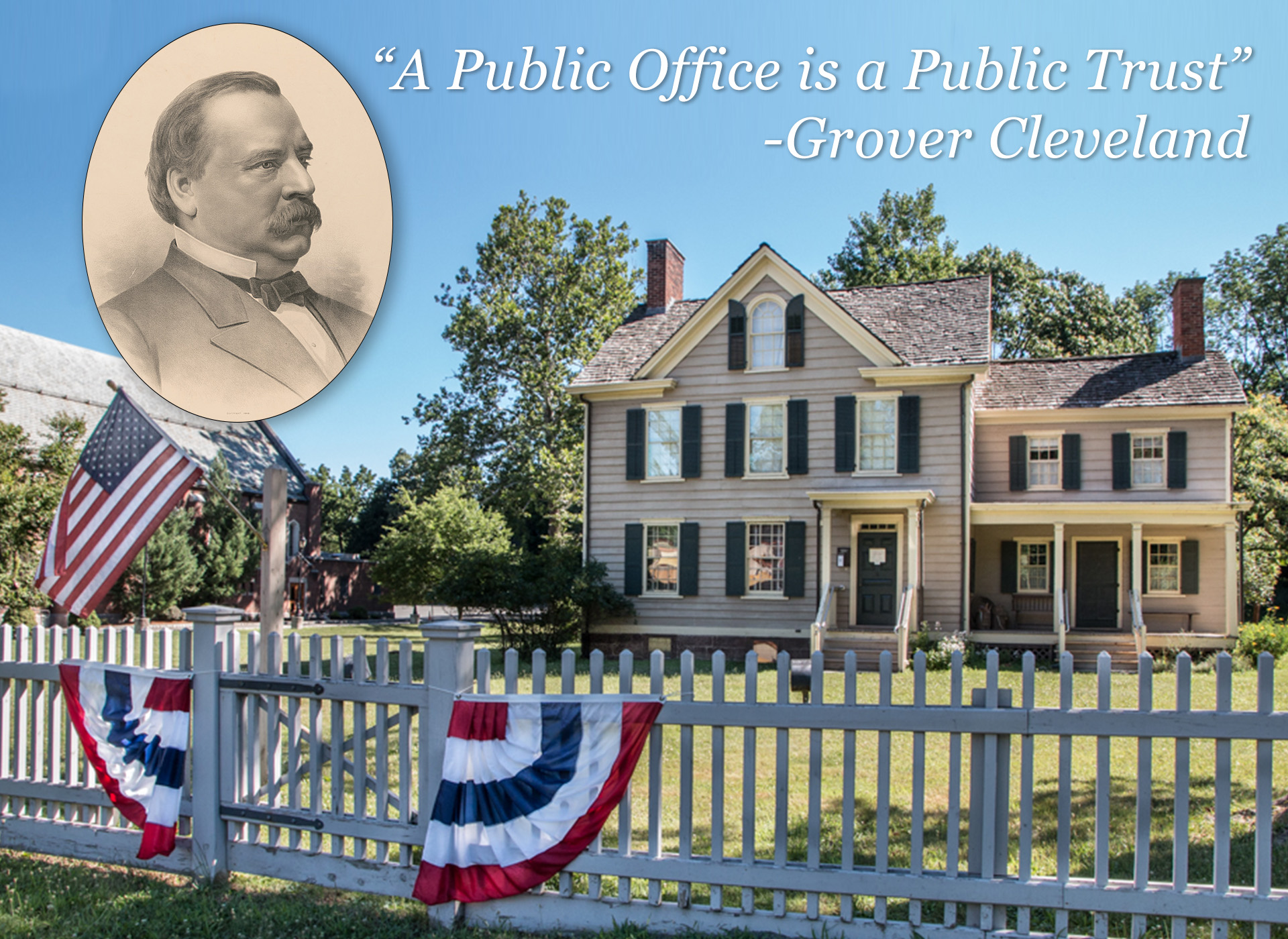
Grover Cleveland was born on March 18, 1837, in a small frame house on what is now Bloomfield Avenue in Caldwell, New Jersey. On Saturday, March 21st, a group of amateur radio operators will gather at that same address to mark the occasion — setting up two HF stations and spending the day in contact with stations across the country and beyond. The connection between a nineteenth-century president and a morning of shortwave radio is less obvious than it sounds, but more interesting.
Cleveland came into the world in a town small enough that a Presbyterian minister’s family was a local institution in itself. His father, the Reverend Richard Cleveland, ran his parish with the kind of sober industriousness that provincial New Jersey rewarded. The family didn’t stay long — they moved north to upstate New York while Grover was still young — but the birthplace stuck, the way birthplaces do, as a fixed point from which a life can be measured. He became, eventually, the first man to serve two non-consecutive terms as president — the 22nd and the 24th, with Benjamin Harrison in between — and was remembered as a man of stubborn honesty in an age when that quality was rarer than it should have been.
What tends to be forgotten is that Cleveland governed during the years when American communications began to harden from improvisation into infrastructure. The telegraph had already remade the country once. Now the undersea cables were threading the ocean floors, the telephone was finding its way into offices and homes, and the question of who would protect these systems — and how — had become genuinely urgent. Cleveland signed the Submarine Cable Act in 1888, which recognized in law what common sense had already established in practice: that long-haul communications links were not luxuries but lifelines, and that their disruption was a matter of public consequence. A year earlier, he had appointed Adolphus Greely as Chief Signal Officer of the Army, lending institutional weight to the proposition that disciplined, reliable communication was something the country had an obligation to sustain.
Cleveland was no radio man. He lived just long enough to share an era with the first broadcasts — dying in 1908, about a year and a half after the Christmas Eve 1906 transmission often credited to Reginald Fessenden as an early broadcast of voice and music — but there is no reason to think the new medium registered for him as anything more than a curiosity, if it registered at all. What mattered to him was the infrastructure already in place: the cables, the wires, the institutions built around them. But it does make the choice of his birthplace for a special event station something more than sentiment.
The house itself has been in careful hands for over a century. The Grover Cleveland Birthplace Memorial Association was founded in 1913 — the same year the building first opened to the public as a museum — and has worked ever since to preserve both the structure and the story it contains. The state of New Jersey took over its administration in 1934, and the site is today managed by the Division of Parks and Forestry, with the Association continuing as an active partner. It is listed on the National Register of Historic Places, holds one of the largest collections of Cleveland papers and artifacts in the country, and remains the only house museum in America dedicated solely to his life.
The West Essex Amateur Radio Club will operate under the call sign W2EF from half past eight in the morning until five in the afternoon, and the public is invited — licensed or not. What they’ll find, if they stop in, is a pair of HF stations reaching out to other operators around the world, each exchange a brief handshake between licensed operators who share a common discipline. The operators will be logging contacts, working the bands, and answering questions from anyone curious enough to ask. The skill required to put a signal on the air and bring one back belongs to the same family as the discipline the telegraph and cable operators of Cleveland’s era cultivated over years at the key.
That is the thread connecting a nineteenth-century president to a Saturday afternoon in Caldwell. America has always depended, in the end, on people who understood that communication across distance is not magic — it is engineering, and patience, and the willingness to learn a system thoroughly enough to trust it. Cleveland’s era was absorbing that lesson at the national scale. On the 21st, in the town where he was born, it will be on display again.
The event is free and open to the public. The Grover Cleveland Birthplace Historic Site is at 207 Bloomfield Avenue, Caldwell, New Jersey. Doors open at 8:30 AM.
Leave a Reply